A practical guide to product management grounded in Christian stewardship. The revised edition follows the product lifecycle, from understanding people and choosing a direction to reliable delivery, responsible AI, and product renewal or retirement.
Revised edition · 24 chapters · Fundamentals and Advanced Practice
Chapter 1: Understanding Products, Users, and Value
Learn to define a product, distinguish users from other stakeholders, separate outputs from outcomes and impact, and write a product brief that makes its assumptions clear.
Explore creation, fall, redemption, and restoration, and connect Christian convictions to product responsibilities while recognizing the limits of what a product can accomplish.
THE PRODUCT STEWARD
— 3
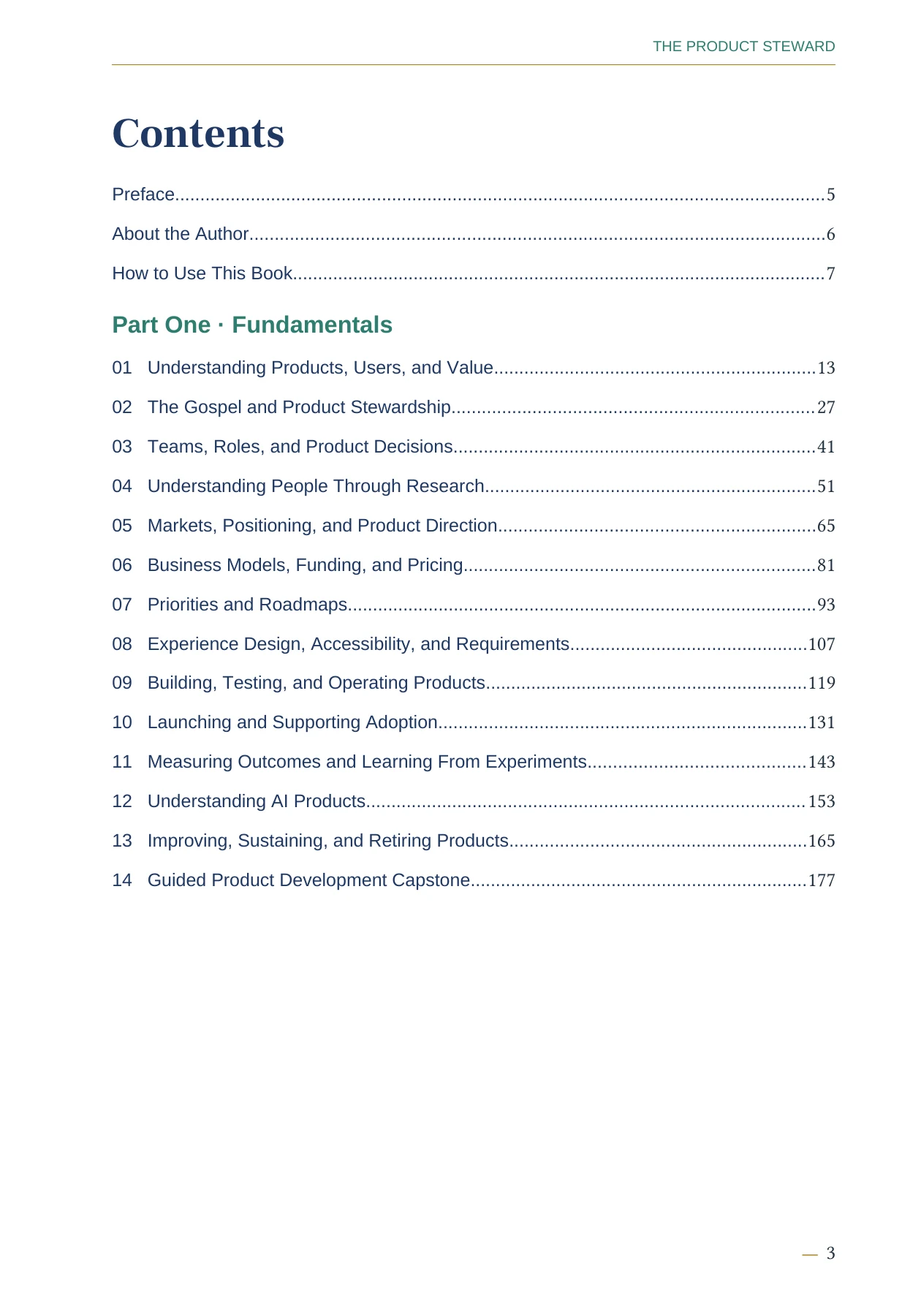
Contents
Preface.................................................................................................................................5
About the Author..................................................................................................................6
How to Use This Book..........................................................................................................7
Part One · Fundamentals
01 Understanding Products, Users, and Value................................................................13
02 The Gospel and Product Stewardship........................................................................27
03 Teams, Roles, and Product Decisions........................................................................41
04 Understanding People Through Research..................................................................51
05 Markets, Positioning, and Product Direction...............................................................65
06 Business Models, Funding, and Pricing......................................................................81
07 Priorities and Roadmaps.............................................................................................93
08 Experience Design, Accessibility, and Requirements...............................................107
09 Building, Testing, and Operating Products................................................................119
10 Launching and Supporting Adoption.........................................................................131
11 Measuring Outcomes and Learning From Experiments...........................................143
12 Understanding AI Products.......................................................................................153
13 Improving, Sustaining, and Retiring Products...........................................................165
14 Guided Product Development Capstone...................................................................177
FAITH · PRODUCT · TECHNOLOGY
— 4
Contents (continued)
Part Two · Advanced Practice
15 Discovery and Strategy Under Uncertainty...............................................................191
16 Product Economics, Pricing, and Growth..................................................................203
17 Analytics, Experimentation, and Causal Reasoning.................................................215
18 Complex Product Design and Reliable Delivery.......................................................227
19 AI Opportunities, Architecture, and Operating Costs................................................237
20 AI Evaluation and Agent Authority.............................................................................251
21 Data Governance and Responsible AI......................................................................269
22 Leadership, Portfolios, and Product Operations.......................................................279
23 Product Renewal and Responsible Retirement........................................................291
24 Advanced Stewardship Capstone.............................................................................301
Reference material
A Quantitative Reference...............................................................................................313
B Illustrative Product Episodes.......................................................................................319
C Reusable Decision Templates....................................................................................327
D Glossary......................................................................................................................355
E Sources and Further Study.........................................................................................373
F Frameworks and Technical Extensions......................................................................377
Acknowledgments............................................................................................................387
Topic Index.......................................................................................................................389
Chapter 1 · Understanding Products, Users, and Value
01
Understanding Products, Users, and Value
EPIGRAPH
“The LORD God took the man and put him in the garden of Eden to work it and keep it” (Genesis 2:15).
Concrete Situation and Opening Decision
ILLUSTRATIVE CASE EPISODE
Maya, a product manager, meets Elena, who coordinates volunteers across several community organizations. Elena wants a directory, messaging, events and a dashboard. Her volunteers want fewer missed handoffs. With one small team and a limited budget, Maya must decide whether to fund the requested features or first investigate the coordination problem. The first product decision is about the need worth serving.
LEARNING OBJECTIVES
By the end of this chapter, you should be able to define a product, distinguish users from other stakeholders, separate outputs from outcomes and impact, explain the main responsibilities of product management, and write a product brief whose assumptions remain visible.
Key terms
Product; project; user; customer; beneficiary; output; outcome; impact; product management
Core Explanation and Visual Anchors
1.1 What makes something a product
A product is an offering through which an organization helps people achieve something they value. The offering may combine software, physical goods, information, human service, and operational processes. A digital application is often the visible part of a larger service.
FIGURE 1.1 Outputs contribute to outcomes through mechanisms that require evidence. Outcomes may contribute to wider impact alongside other influences.
Consider online appointment booking. The interface helps a person choose a time, but the value depends on accurate availability, confirmation, staff preparation, accessibility, cancellation, and support when something goes wrong. A polished screen connected to an unreliable service does not deliver the promised experience. Product decisions therefore extend beyond the screen.
For the illustrative community case, the visible action might be posting a support request. The wider experience includes understanding the audience, entering an appropriate community, receiving a response, reporting misuse, and correcting a mistake. These relationships explain why a product cannot be adequately described by a list of pages.
Products differ from projects. A project organizes bounded work toward a defined result, often within a schedule and budget. A product may require many projects as it develops and continues to serve people. A project to introduce a new registration flow can finish while responsibility for registration remains. Neither concept is superior; they describe different aspects of organized work.
A service is an arrangement through which people receive assistance or accomplish a task. A product may enable a service, and a service may include several products. Organizations use the terms differently, so ask what responsibilities a label includes before assuming a universal boundary.
1.2 Who receives value and who decides
A user interacts with the product. A customer buys it or enters the commercial relationship. A beneficiary receives some of its intended benefit. A funder supplies resources. An administrator configures or governs its use. A stakeholder is anyone who can affect the product or experiences its consequences. One person can hold several of these roles, but the roles should not be collapsed automatically.
An employer may buy software that employees must use. A public agency may fund a service used by citizens. A community organization may administer an application through which members share sensitive information. In each case, the purchaser's preferences are relevant but do not exhaust the product's responsibilities.
The person described in a support request may never open the community service. The product can still affect that person's privacy and reputation. Identifying indirect stakeholders helps the team see consequences that a conventional user count misses.
Value is also contextual. A quick action may be valuable when someone is short of time, but speed may be less important than confidence when the action discloses personal information. More activity may indicate useful participation, confusion, or pressure. A product manager must state the proposed benefit precisely enough to investigate it.
Ask three questions at the beginning of a product discussion: Who is trying to accomplish what? Under which circumstances? What makes the current alternative inadequate? An answer such as “everyone needs community” expresses a broad human concern. It does not yet identify an actionable product opportunity.
1.3 Outputs, outcomes, and impact
An output is something the team produces: a feature, document, campaign, or release. An outcome is a change in behavior, experience, or performance that the team seeks. Impact concerns the broader consequence for people or the organization. These distinctions help a team explain why an output deserves investment.
For example, adding an audience selector is an output. Improving members' understanding of who can read a request is an outcome. Reducing avoidable disclosure and sustaining trust are possible impacts. The links are hypotheses. The team must examine whether the selector actually improves understanding and whether that improvement affects disclosure in practice.
The distinction does not make outputs unimportant. People cannot benefit from a capability that the team never delivers. It changes how delivery is judged. Completing ten features is evidence of production, not necessarily evidence that people are better served.
Some outcomes lie partly outside the team's control. A community's response to a request depends on relationships, leadership, available time, and circumstances beyond software. Responsible product management identifies the contribution the product can plausibly make without claiming ownership of every human result.
MODEL IN DEPTH · An outcome statement
The following example improves an outcome statement for the illustrative community service.
Weak statement: “Launch anonymous support requests and increase engagement.” This combines an output with an undefined measure. It leaves the audience, intended benefit, meaning of anonymity, and possibility of harm unspecified.
Stronger statement: “Help members who choose a limited audience understand and control where their request appears, while maintaining a clear route to report a mistaken disclosure.” This identifies a proposed benefit and an obligation. The team still needs evidence about whether the problem exists, how members understand audience boundaries, and which controls would address it.
An initial measure could examine whether research participants correctly explain the intended audience after using a prototype. A supporting measure could examine completion without assistance. A guardrail could track serious misunderstandings during the study. None proves that the eventual service will prevent every disclosure. Each informs a particular decision.
1.4 Product judgment combines several questions
A promising product direction must address people's needs, work in practice, and fit the organization's ability to sustain it. Teams often discuss desirability, feasibility, and viability. Desirability asks whether people want or need the proposed value. Feasibility asks whether the team can deliver the required performance with available technology and resources. Viability asks whether the arrangement can operate sustainably within the organization's constraints.
Usability deserves separate attention: people may want an outcome yet be unable to achieve it through the design. Ethical and legal obligations also remain relevant even when an idea appears attractive, feasible, and financially viable. A product can satisfy those three commercial tests and still impose unacceptable harm.
FIGURE 1.2 Desirability, usability, feasibility, and viability identify different uncertainties. Evidence in one area does not resolve the others.
These categories organize investigation. They are not gates through which every team must pass once in a fixed order. A technical prototype may reveal a cost problem; a pricing test may reveal a misunderstood user need. The team should investigate the uncertainty most likely to change the decision, while preserving essential safeguards.
Cagan's discussion of value, usability, feasibility, and business viability offers a related account of product risk. Use such frameworks to clarify questions and responsibilities, not to claim that following a diagram guarantees success. (Cagan 2018)
Compare the four product risks
Cagan's four-risk framework helps a team choose what to investigate next. Use the questions together: a design may be easy to use and technically feasible while solving a problem that customers will not pay to address. (Cagan 2018; Cagan 2017)
TABLE 1.1 Compare the four product risks
Risk | Question | An appropriate investigation
Value | Will the intended customer choose or use this? | Observe alternatives and test a credible offer
Usability | Can people achieve the intended result? | Observe realistic tasks with a prototype
Feasibility | Can the team build and operate it within constraints? | Test the uncertain technical mechanism
Business viability | Can it work within the organization's business and obligations? | Examine economics, distribution and operating requirements
The columns identify inquiries, not a fixed sequence of approvals. Start where a finding could most change the decision.
1.5 What product managers actually do
Product managers help a team connect evidence, direction, and action. Their recurring work includes discovering needs, choosing a strategy, coordinating delivery decisions, aligning stakeholders, and learning from results. The balance varies by organization, product stage, and the capabilities of colleagues.
Discovery asks what people need and which assumptions deserve investigation. Strategy chooses where the organization will focus and why. Delivery turns a chosen direction into a dependable experience. Alignment helps people with different responsibilities understand and support the decision. Measurement examines what happened and what should change.
These activities overlap. A support incident can reveal a discovery question. An engineering constraint can change a strategy. A market change can require a different business model. The role therefore depends on sustained collaboration rather than a clean division between thinking and execution.
A product manager is rarely the chief executive of a miniature company. The role may carry accountability without authority over design, engineering, sales, finance, or operations. Influence comes from credible reasoning, reliable collaboration, and an understanding of the constraints others manage. Where authority is unclear, the organization must define it rather than expect personality to resolve every disagreement.
Product marketing contributes positioning, market understanding, messaging, and adoption. Design contributes research and the structure of the experience. Engineering contributes technical judgment, implementation, and operational knowledge. Project and program management can coordinate dependencies, schedules, and complex delivery. The product manager's contribution depends on how these responsibilities fit together, not on claiming exclusive ownership of all consequential questions.
FIGURE 1.3 The five recurring responsibilities of product management connect discovery, strategy, delivery, alignment and measurement. Alignment includes the work sometimes called product evangelism: helping others understand and support a worthwhile direction.
Compare neighboring roles
Roles work best as complementary responsibilities. In a small organization one person may perform several; in a larger organization each may have a specialist. The Product Owner row describes Scrum's specific accountability. The other rows describe common professional practice rather than a universal organization chart. (Schwaber and Sutherland 2020)
TABLE 1.2 Compare neighboring roles
Role | Typical focus | Core question
Product manager | Direction, customer value, viability and outcomes throughout the lifecycle | Which problem deserves investment, and what result would show progress?
Product Owner in Scrum | Maximizing product value and effective Product Backlog management | How should the Product Goal and ordered backlog guide the work?
Project manager | A defined initiative's scope, schedule, resources, dependencies and risks | How will this initiative meet its agreed objectives and constraints?
Program manager | Related initiatives, dependencies and shared benefits | How will these efforts achieve the intended benefits together?
Product marketing manager | Market understanding, positioning, messaging, launch and commercial enablement | Why should this audience choose the product, and how will we reach it?
The discipline has several inheritances
Product management draws on brand management, operations, design, engineering and entrepreneurship. Neil McElroy's 1931 brand-management memo called for responsibility close to a brand's market and performance. Lean production emphasized flow and learning about work. Agile software development strengthened short feedback cycles; Lean Startup connected experiments with uncertain business assumptions. These influences overlap. They do not form a single clean succession in which one method replaces all earlier ones.
FIGURE 1.4 Several traditions contribute to product management. The sequence is an orientation to ideas, not a claim that all organizations followed the same historical path. Sources: McElroy's 1931 memo; the Agile Manifesto; Ries, The Lean Startup.
Product roles also specialize. A core-product PM develops a service's central value; a growth PM investigates acquisition, activation and retention; a platform or technical PM serves capabilities used by other teams; an AI or data PM works with learned behavior, data and evaluation. The underlying responsibility remains similar: connect a worthwhile problem with a sustainable response. A T-shaped skill profile combines depth in one domain with enough breadth to collaborate across the others.
1.6 A product brief makes the initial argument inspectable
A product brief states enough of the argument to support the next decision. It should be short enough to revise when evidence changes and specific enough to expose disagreement. A long document that conceals uncertainty is less useful than a concise document that identifies it.
Use the following fields: intended population; circumstance and problem; current alternatives; proposed outcome; organizational purpose; constraints; major assumptions; evidence available; evidence missing; next decision; and decision owner. At an early stage, many fields will contain hypotheses. Label them accordingly.
MODEL IN DEPTH · A bounded community brief
Population and circumstance: Members of participating communities who wish to request support while limiting the audience. This is the proposed research population, not an established segment.
Problem hypothesis: Existing sharing options may leave some members uncertain about who can read a request. The hypothesis requires interviews and observation; the team should also investigate whether existing tools already serve the need adequately.
Current alternatives: Speaking privately with a leader, using a messaging group, calling a trusted person, or choosing not to share. The product must improve on a relevant alternative, not merely differ from another application.
Proposed outcome: Members can make an informed audience choice and obtain support without unnecessary disclosure. The proposed measure of comprehension is narrower than the wider outcome of support.
Constraints: Limited development and moderation capacity; sensitive content; differing access needs; and the need to explain what the service can and cannot promise.
Next decision: Whether to test a low-fidelity audience-selection prototype with a suitably recruited group. A favorable decision authorizes the test, not a full launch.
Evidence required: Observations of existing behavior, participants' explanations of audience expectations, and prototype comprehension. Evidence about long-term benefit will require later study.
This brief creates a shared object for discussion. An engineer can identify a permissions problem. A researcher can challenge the population. A community leader can describe an operating burden. A member can dispute the assumed need. The brief improves when those challenges produce clearer reasoning.
Faith and Practice Reflection
FAITH & PRACTICE
Elena's request deserves attention because her work and the people who depend on it matter. Stewardship begins by receiving that responsibility carefully: listen before prescribing, identify whose time the proposal consumes, and make the intended benefit explicit. A useful product can relieve a real burden. Its value begins with people, not a feature count.
1.7 Stewardship begins with the people affected
Every definition of product value implies a judgment about people. A conversion rate counts an action; it cannot exhaust the worth of the person who acts. The Christian account developed in Chapter 2 grounds that worth in creation in God's image and places professional work within the Gospel's larger story.
This conviction sharpens the product question. A member may be better served by sharing less, declining an invitation, or choosing another service. Growth can accompany value, but the relationship must be examined. Begin with the people affected.
Sustaining the service matters for the same reason. When people depend on a product, its funding, reliability, and capacity become part of the promise. Stewardship therefore joins care for people with competence in the means of serving them.
Actionable Application
MODEL IN DEPTH · Worked scenario
Maya rewrites ‘launch a volunteer dashboard’ as ‘help coordinators fill open shifts with fewer manual follow-ups.’ The dashboard is a possible output; fewer follow-ups is a candidate outcome. She plans to observe the existing workflow before choosing a solution. Her initial brief names coordinators and volunteers separately because an improvement for one group could transfer work to the other.
Project worksheet
Complete the fields for your project, using the worked scenario as a guide. Keep each response specific enough to inform a decision.
TABLE 1.3 Project worksheet
Worksheet field | Complete for your product | Your response
People and circumstance | Who needs to accomplish what, and when? | ________________
Current alternative | How do they manage the task without your product? | ________________
Proposed outcome | What useful change should they experience? | ________________
Possible output | Which feature or service might contribute? | ________________
Assumption to investigate | What could make the proposed solution unnecessary? | ________________
Next decision and owner | Who will decide what to do after the inquiry? | ________________
Chapter summary
Product management connects human needs, organizational purpose and the means of delivering value. Outputs matter because of the outcomes they can support. The PM coordinates discovery, strategy, delivery, alignment and measurement across the product's life.
APPLICATION · Guided practice
An organization proposes “Build a new dashboard so leaders can see more member activity.” Identify the output, a possible outcome, two affected stakeholders, and one assumption that deserves investigation before development.
Guidance: The dashboard is the output. A possible outcome is that leaders identify unmet support needs more accurately, but more visible activity does not establish that outcome. Members and people mentioned in their posts are affected alongside leaders. Investigate whether the proposed data actually helps identify a need and whether collecting or displaying it would violate reasonable expectations.
APPLICATION · Independent application
Write a one-page product brief for a digital service you know. Label every unsupported proposition as a hypothesis. Identify an existing alternative that does not involve a competing application. State the next decision and the evidence that could cause you to recommend stopping.
Review questions
Explain why a shipped feature is not sufficient evidence of user value. Describe a situation in which the buyer and beneficiary disagree. Distinguish feasibility from viability. Explain why a product brief should include a decision owner and a condition for reconsideration.
YOUR DECISION ARTIFACT
Retain your product brief. In Chapter 4 you will investigate one of its assumptions. In Chapter 7 you will decide which opportunity deserves limited resources. The brief should change as the quality of the evidence improves.
Sources and Further Study
Cagan, Marty. 2018. Inspired. 2nd ed. Wiley.
Government Digital Service. 2016. “How the discovery phase works.” This public service guidance offers a concrete account of investigating needs and constraints before committing to a solution.
Association for Computing Machinery. 2018. Code of Ethics and Professional Conduct. Its treatment of affected people and professional responsibility provides a nonsectarian comparison for the ethical questions developed in this book.
McElroy, Neil H. 1931. Brand management memorandum, May 13. Facsimile.
FUNDAMENTALS
Chapter 2 · The Gospel and Product Stewardship
02
The Gospel and Product Stewardship
EPIGRAPH
“It is required of stewards that they be found faithful” (1 Corinthians 4:2, excerpt).
Concrete Situation and Opening Decision
ILLUSTRATIVE CASE EPISODE
Elena has a difficult funding choice. A sponsor will support the community platform if the team emphasizes visible activity, yet quiet forms of help may serve people better. Maya can explain the measurement problem; Elena wants to understand the purpose beneath it. What makes work good, why does it go wrong, and what can a product reasonably promise? Christian stewardship answers within the larger story of creation, fall, redemption and restoration.
LEARNING OBJECTIVES
Explain the Gospel through creation, fall, redemption, and restoration; distinguish salvation from moral improvement or professional achievement; describe repentance, faith, and grace in plain language; connect Christian convictions to specific product responsibilities without turning biblical passages into management formulas; and identify limits on what a product can accomplish.
Key terms
Gospel; creation; fall; redemption; restoration; oikonomos; sub-creation; common grace; vocation
Core Explanation and Visual Anchors
2.1 Creation: God gives life, dignity, and responsibility
Genesis presents God as the creator of a world he calls good. Human beings belong to this creation and bear his image. The text places human life within a relationship of dependence and responsibility: people receive life, inhabit a world they did not make, and exercise a vocation within it. The Christian account of dignity developed here follows from that relationship. A person's worth does not depend on intelligence, health, social standing, productivity, belief, or commercial value. (Genesis 1:26–31)
FIGURE 2.1 Creation, fall, redemption, and restoration describe the biblical narrative. Christ's saving work gives the sequence its center; product development is a field of responsibility within that story.
Genesis 2 describes work before the account of human disobedience. Cultivating and caring for the garden belong to the original human vocation. Work therefore has a positive purpose even though much work later becomes frustrating, exploitative, or exhausting. Rest also belongs to the creation narrative. Human beings receive limits; continuous production is not the measure of a complete life. (Genesis 2:1–3, 15)
Creation gives product work a positive but bounded purpose. Teams can use creativity and technical skill to serve others, drawing on materials, attention, time, trust, and labor that remain finite. The person represented by a database record exceeds every role the system assigns. Commercial value does not confer dignity.
The language of sub-creation illuminates this dependence. J. R. R. Tolkien used the term for the artist's making of a secondary world within God's primary creation. Applied here by analogy, it describes human creativity as received and derivative: a product team shapes possibilities it did not originate. The term honors imagination while resisting the idea that technical power makes its possessor ultimate. (Tolkien 1964)
The application requires judgment. Genesis does not prescribe a particular interface, business model, or development method. A team must investigate how its decisions affect people in the actual context. The theological claim establishes why those consequences deserve attention; research and professional expertise help the team understand them.
MODEL IN DEPTH · Dignity and access
Consider an illustrative community application whose simplest onboarding flow requires a recent smartphone, reliable connectivity, and fluent English. The organization wants people to participate, but the design may exclude some of the intended community. A commitment to dignity does not automatically identify the best remedy. It requires the team to investigate who cannot participate and to evaluate reasonable ways to include them.
Possible responses include a simpler web experience, translated guidance, assisted onboarding, compatibility work, or an alternative service channel. Each has costs and limitations. The team should explain its decision through evidence about the affected population, available resources, and the consequences of exclusion. An assertion that “we value everyone” is incomplete until it shapes the work.
2.2 The fall: Sin distorts persons and institutions
Genesis 3 describes human distrust and disobedience toward God, followed by shame, accusation, alienation, and painful consequences. Scripture's wider diagnosis includes every person: sin is not confined to unusually malicious individuals or poorly designed organizations. It concerns a disordered relationship with God that also distorts our desires and conduct. (Genesis 3; Romans 3:23)
In ordinary language, sin names the failure to love, trust, and obey God as we should. It includes wrongful actions and the disposition that produces them. Repentance, developed later in this chapter, involves turning from that condition toward God. These theological terms should not be reduced to mistakes, low performance, or an inconvenient user experience.
Product organizations provide many opportunities for self-deception. A team may choose the favorable denominator, redefine success after seeing the result, or describe an uncertain capability as reliable. Leaders may dismiss criticism because the organization has a worthy mission. Employees may recognize a problem but fear the cost of reporting it. Incentives can reinforce these patterns even when no individual designed the entire system to cause harm.
Personal and institutional explanations should be examined together. An incentive does not remove an individual's responsibility, and an individual's failure does not establish that the institution's arrangements were sound. A responsible review asks what a person did, what authority and information they had, and which structures made the conduct more likely or harder to challenge.
This account also counsels humility about the observer. The product manager is not the one clear-sighted person surrounded by biased stakeholders. Researchers, engineers, executives, ministers, and users all bring limited knowledge and interests. The appropriate response is to make important claims inspectable, invite challenge, and create procedures that can correct error.
MODEL IN DEPTH · A misleading success story
Suppose a team reports that a new onboarding flow doubled participation. The reported comparison includes only people who finished registration. Those who abandoned the new flow are absent from the denominator. The attractive result may therefore conceal a worse experience for the population the team intended to serve.
An immediate technical response is to repair the analysis. A broader organizational response examines why the team selected the denominator, who reviewed the claim, and whether incentives discouraged inconvenient findings. A Christian moral response includes truthfulness, acknowledgment of responsibility, and appropriate repair. These responses complement one another. A corrected spreadsheet alone may leave the incentive intact; remorse without corrected evidence leaves the decision unreliable.
2.3 Redemption: God acts through Jesus Christ
The Gospel announces God's action to save. The New Testament presents Jesus as the eternal Son who became human, lived faithfully, proclaimed God's kingdom, died for sins, and rose bodily from the dead. His work addresses the alienation and guilt that human beings cannot remove through achievement or moral effort. (John 1:1–14; 1 Corinthians 15:1–8)
The incarnation means that the Son of God truly became human. The atonement concerns Christ's saving work through his death, by which sinners are reconciled to God. The resurrection means that Jesus was raised from death; Christian hope rests on this claim as an event, not merely a symbol of renewed motivation. Christians have developed detailed accounts of these doctrines, but their central place in the Gospel should remain clear before professional applications are drawn.
Paul describes salvation as a gift of grace received through faith. Grace is God's undeserved favor and generosity toward sinners. Faith involves trusting Christ and relying on him rather than treating one's achievements as the basis of acceptance with God. Good works follow this gift as part of a renewed life; they do not purchase it. (Ephesians 2:1–10)
Jesus calls people to repent and believe the good news. Repentance includes acknowledging sin and turning toward God. It is more than regret over consequences or an attempt to improve one's public image. Faith is more than agreeing that Christianity has useful professional values. It concerns trust in Jesus Christ himself. (Mark 1:14–15)
This distinction protects the book's central argument. Ethical product work cannot reconcile a person to God. A successful application cannot atone for sin. A socially beneficial organization cannot confer salvation on its founder, employees, or customers. The Christian's work is a response to grace and an opportunity to serve, rather than a means of earning acceptance with God.
The Gospel also gives a different account of identity. A product can fail without determining the ultimate worth of the person who built it. This does not excuse incompetence or remove consequences. It challenges the pressure to defend an achievement at any cost because one's entire identity depends on it. A leader who can acknowledge failure has a better opportunity to correct it than a leader who must conceal it to preserve a sense of worth.
The Holy Spirit and renewed life
The New Testament describes the Holy Spirit as the one who gives life and forms the character of those who belong to Christ. Christian growth involves an ongoing change in conduct, relationships, and desires. It occurs through dependence on God within a community of faith, not through the isolated pursuit of professional virtue. (Romans 8:1–17; Galatians 5:13–26)
The church has a distinct role as a community that worships, teaches, serves, and bears witness to Christ. A Christian application may support aspects of community life, but participation in an application does not establish spiritual maturity. Activity metrics cannot measure reconciliation with God, and a product team should not claim that they do.
A community product can help people communicate, find resources and organize support. Assess its value through those contributions. Pastoral authority, the responsibilities of a local church and judgments about spiritual life belong outside an application's engagement score.
MODEL IN DEPTH · Grace and accountable repair
Imagine that an audience-control defect exposes a member's request to unintended readers. The team must contain the problem, establish what happened, communicate accurately, and support affected people. It should preserve necessary evidence while respecting the sensitivity of the content.
A leader may be tempted to minimize the event because the organization serves a Christian mission. The Gospel provides no exemption from truthfulness. Repentance requires acknowledgment and a changed course. Forgiveness does not mean that an injured person must immediately restore trust, abandon an appropriate complaint, or accept unchanged authority. Accountability can require restitution, removal of access, altered responsibilities, or independent review.
Grace and professional competence meet in the concrete work of repair. The team should correct the defect, examine adjacent failure paths, revise misleading promises, and change any incentive that rewarded concealment. The moral and technical tasks cannot be collapsed into a statement of good intentions.
2.4 Restoration: God will renew creation
Christian hope looks toward the consummation of God's saving work. Revelation describes a renewed creation in which God dwells with his people and death, mourning, and pain no longer define their life. This hope extends beyond improved institutions or technological progress. Its fulfillment belongs to God. (Revelation 21:1–5)
The New Testament also describes a tension between what has begun through Christ and what awaits completion. Christians live with genuine hope while still facing suffering, sin, uncertainty, and death. This guards against two opposite errors: despair that treats responsible work as pointless, and overconfidence that treats human achievement as the arrival of God's final restoration.
Product work can address real needs within this unfinished world. A reliable service may reduce confusion or help people obtain support. An accessible design may expand participation. A responsible retirement plan may protect people from avoidable disruption. These are meaningful goods. They do not justify a claim that the team is engineering the kingdom of God or completing redemption through software.
Restoration also places limits on an organization's survival claims. No individual product must exist forever. A feature can be retired responsibly when another arrangement serves people better. The Christian's hope does not depend on preserving a company, application, or professional reputation at any cost.
2.5 Stewardship names an entrusted responsibility
A steward manages what another has entrusted. The Greek term oikonomos, often rendered “steward” or “household manager,” makes that relationship concrete: authority is exercised on another's behalf. In 1 Corinthians 4:1–2, Paul applies the image to servants of Christ entrusted with the mysteries of God. Product leadership draws an analogy from this account; it does not acquire apostolic authority.
Christian stewardship extends the question of entrusted responsibility to life, abilities, resources, opportunities, and authority. Who entrusts them, what purposes should they serve, and how will their use be accounted for? These questions give professional responsibility a theological horizon.
Applied to product work, the entrusted resources include money, labor, time, attention, data, institutional trust, and technical power. Their use should be judged by more than the steward's convenience. A manager who controls an employee's workload, a moderator who can restrict participation, and an engineer who can access sensitive data each exercise a form of entrusted authority.
Define the extent of the entrusted responsibility. A product team must explain what its service undertakes to provide, which dependencies affect that promise, and where another professional or institution must act. Overclaiming creates promises the team cannot keep; understating its role can conceal foreseeable consequences.
The term also appears in organizational research. Stewardship theory examines assumptions and conditions concerning managers who act in the interests of an organization. That research tradition is related to, but distinct from, the theological argument here. It does not establish Christian doctrine, and the doctrine does not establish that every leader will behave as an organizational steward. (Davis, Schoorman, and Donaldson 1997)
2.6 Connect belief to a decision without skipping the reasoning
A sound application proceeds through four steps. First, identify the biblical passage's context and subject. Second, explain the theological principle drawn from it. Third, investigate the product circumstances to which the principle may apply. Fourth, justify the proposed action and acknowledge the analogy's limits.
For example, biblical teaching about truthful speech gives a Christian reason to reject misleading performance claims. Whether a particular claim misleads depends on its wording, evidence, audience, and likely interpretation. The team must inspect the benchmark, denominator, uncertainty, and operating context. Scripture does not supply the missing statistical analysis.
Similarly, love of neighbor may motivate accessible design. Determining which barriers a particular interface creates requires research, technical standards, and testing. A verse attached to an inaccessible screen does not discharge the obligation.
Use caution with passages whose familiar wording appears to resemble management language. Proverbs 29:18 concerns prophetic vision and keeping the law; it does not directly endorse a corporate vision statement. A managerial analogy, if used, should be identified and bounded. The goal is to hear the passage's claim before recruiting it to support a preferred practice.
A four-movement decision reflection
TABLE 2.1 A four-movement decision reflection
Movement | Question for the practitioner | Boundary
Creation | What human good and entrusted resources does this decision concern? | Commercial demand alone does not define dignity
Fall | How could self-interest, deception, or distorted incentives affect our judgment? | Naming bias does not prove that we have corrected it
Redemption | How should grace, repentance, and truthful accountability shape our response? | Product improvement does not accomplish salvation
Restoration | What responsible good can we pursue while acknowledging our limits? | A product's success is not the fulfillment of Christian hope
This reflection supports judgment; it does not generate a predetermined answer to every roadmap dispute. Two faithful people may disagree about the most responsible allocation of resources. They should explain the evidence, obligations, assumptions, and tradeoffs that lead to their conclusions.
2.7 Work with people who hold different convictions
Professional collaboration does not require identical beliefs about the ultimate basis of human dignity. A Christian and a non-Christian colleague may both oppose deceptive design, support accessible participation, and insist on accurate measurement. They can explain their reasons honestly while working toward a shared decision.
Respect includes making the Christian claim intelligible rather than hiding it in vague language. It also includes recognizing a colleague's freedom to disagree. Authority over employment, grades, access, or institutional participation should not be used to compel a profession of faith. The book's exercises invite analysis of beliefs and their consequences without treating religious assent as a substitute for academic work.
The Gospel remains an invitation addressed to persons. If its claims are unfamiliar, begin by reading a Gospel account such as Mark and the passages discussed in this chapter. Consider who Jesus claims to be, what his death and resurrection mean, and why he calls people to repent and believe. A trusted Christian and a local church can help you examine these questions. The response Christianity commends is trust in Christ, not merely adoption of a more ethical management style.
For Christian readers, this invitation also challenges the separation of belief from conduct. A stated commitment to grace does not excuse harsh leadership. A stated commitment to truth does not justify selective reporting. Growth in faith should become visible in the willingness to serve, learn, acknowledge wrong, and accept appropriate limits.
Faith and Practice Reflection
FAITH & PRACTICE
Common grace gives Christian practitioners a reason to recognize insight and excellent craft wherever they encounter them. A colleague who does not share their faith may perceive a need more clearly, design a more accessible interaction, or expose an unjust incentive. Receive that contribution with gratitude. The Gospel gives work a purpose without making Christians its exclusive source of wisdom.
Virtue becomes visible in a product decision
Common grace describes God's gifts and restraint of evil across human life, including insight and skill among people who do not confess Christian faith. It differs from the saving grace announced in the Gospel. For the Christian product practitioner, the distinction supports both clear conviction and intellectual hospitality: learn from excellent work, credit its source and evaluate its claims fairly. Matthew 5:43–48 locates generosity toward others within God's own indiscriminate provision; it does not make agreement on doctrine a condition of receiving a neighbor's contribution.
The virtues below concern the person who uses a method. A roadmap cannot manufacture humility, and an evaluation score cannot establish justice. Yet character shapes what a practitioner is willing to investigate, report and repair.
TABLE 2.2 Virtue becomes visible in a product decision
Virtue | A concrete product practice | A question for examination
Truthfulness | Report denominators, limitations and unfavorable results | Which fact would change the audience's interpretation?
Humility | Seek correction and revise an assumption | Whose evidence have I dismissed too quickly?
Justice | Examine how benefits and burdens are distributed | Who bears the cost of this convenient choice?
Prudence | Match a commitment to evidence and reversibility | What should we learn before increasing exposure?
Courage | Challenge a misleading promise or harmful incentive | Which necessary objection have I avoided?
Love of neighbor | Make the service usable, supportable and respectful | What does this decision require of the person who depends on it?
Actionable Application
MODEL IN DEPTH · Worked scenario
Elena declines a target that rewards public posting regardless of benefit. She and Maya propose measures of fulfilled requests, coordination effort and participation that people choose freely. The professional argument concerns whether the measures represent useful service. Elena's theological reason reaches further: neighbors bear God's image, and her responsibility to serve them cannot be reduced to activity that pleases a sponsor.
Project worksheet
Complete the fields for your project, using the worked scenario as a guide. Keep each response specific enough to inform a decision.
TABLE 2.3 Project worksheet
Worksheet field | Complete for your product | Your response
Creation | What good in human life is this work intended to serve? | ________________
Fall | Which distorted incentives or harmful effects need attention? | ________________
Redemption | How does grace shape the worker without making the product a savior? | ________________
Restoration | How does Christian hope place ambition and limits in perspective? | ________________
Common grace | Whose insight should you receive across differences of belief? | ________________
Professional decision | What concrete choice follows, and what evidence must still be gathered? | ________________
Chapter summary
The Gospel announces God's saving work in Jesus Christ within the story of creation, fall, redemption and restoration. An oikonomos manages what has been entrusted; sub-creation names derivative human making. Common grace supports generous collaboration, while vocation gives ordinary work dignity and purpose.
APPLICATION · Guided practice
An organization explains a harmful release by saying, “Our mission is good, and our intentions were sincere.” Identify what this explanation establishes and what it leaves unanswered.
Guidance: It states the organization's claimed purpose and motive. It does not establish the quality of its evidence, the adequacy of its controls, the consequences for affected people, or its response to known problems. Examine those matters separately. The Christian account of sin gives reason to scrutinize benevolent self-descriptions, including one's own.
APPLICATION · Independent application
Choose a product decision involving a real tradeoff: accessibility and cost, privacy and measurement, speed and reliability, or funding and independence. Explain one relevant Christian conviction, the empirical information needed to apply it, and two plausible courses of action. Identify a condition under which you would revise your recommendation.
Readers using another ethical framework should state its premises with equal clarity and address the same evidence and consequences. The shared standard is coherent reasoning that affected people can examine.
Review questions
Explain why work can be good even when it is difficult. Distinguish sin from an ordinary technical mistake. Explain grace, repentance, and faith without assuming prior theological knowledge. State why a beneficial product cannot provide salvation. Describe how hope in restoration can support both sustained effort and a responsible decision to retire a product.
YOUR DECISION ARTIFACT
Add a responsibility statement to the product brief from Chapter 1. Identify the people affected, the goods the product seeks to serve, the authority the organization exercises, and a limit it must acknowledge. Revisit this statement when the business model and measurement plan develop.
Sources and Further Study
The biblical argument draws on Genesis 1–3, John 1, Romans 3, Romans 8, Mark 1, 1 Corinthians 15, Ephesians 2, Galatians 5, and Revelation 21. The chapter paraphrases and interprets these passages; it does not present its product applications as part of the biblical text.
Davis, James H., F. David Schoorman, and Lex Donaldson. 1997. “Toward a Stewardship Theory of Management.” Academy of Management Review 22 (1): 20–47.
Keller, Timothy, with Katherine Leary Alsdorf. 2012. Every Good Endeavor: Connecting Your Work to God's Work. Dutton.
Wolters, Albert M. 2005. Creation Regained: Biblical Basics for a Reformational Worldview. 2nd ed. Eerdmans.
Tolkien, J. R. R. 1964. “On Fairy-stories.” In Tree and Leaf. George Allen & Unwin. See also Verlyn Flieger, “On Fairy Stories,” The Tolkien Estate, for the meaning of sub-creation in Tolkien's account.
Mounce, William D. n.d. “Oikonomos,” Greek New Testament Dictionary. The lexical entry identifies the household-management and New Testament stewardship uses. Accessed September 19, 2026.
FUNDAMENTALS